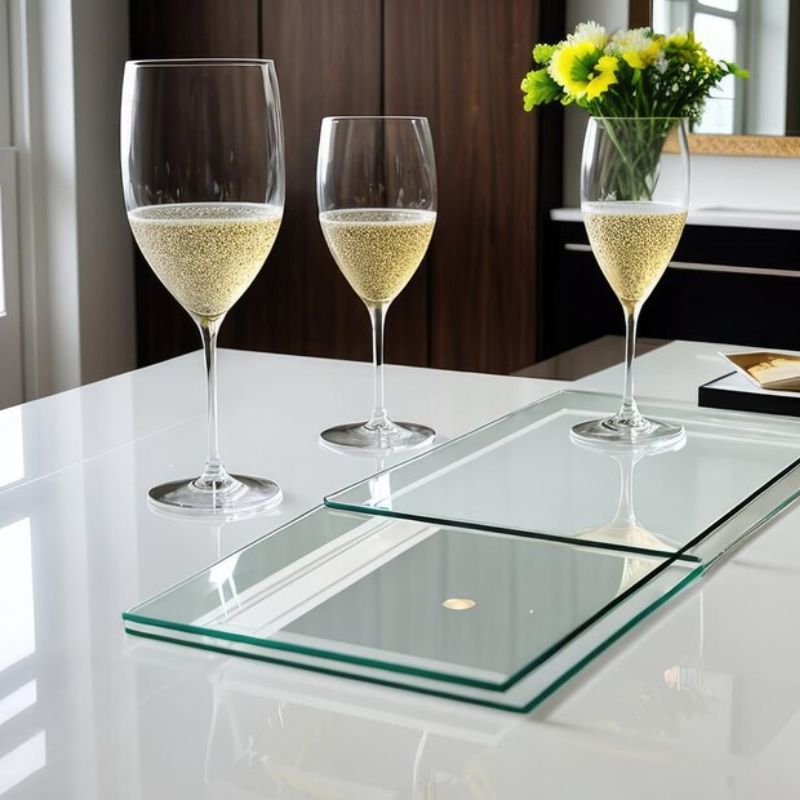
A glass table top can transform a piece of furniture — or protect one you already love. Whether you’re topping a dining table, covering a dresser, or building a desk from scratch with glass on a base, getting the specs right makes the difference between something that looks custom and something that looks like an afterthought.
Here’s what you need to know before ordering.
Sizing: How to Measure for a Glass Table Top
For a table top that sits on an existing piece of furniture (a protector or cover), measure the surface it’s going on:
- Length and width — measure edge to edge at the widest points
- For round tables — measure the diameter
- For irregular shapes — make a template from cardboard or kraft paper
If the glass is going to overhang the base, add the overhang to your measurements. A typical overhang is 1–2 inches on each side.
For freestanding glass tops (glass on a pedestal base, trestle, or legs), the glass size is the full table size. There’s no underlying surface to reference — the glass IS the surface.
Pro tip: Always have a professional verify your measurements. Glass can’t be trimmed after it’s tempered. If it’s wrong, it has to be re-cut and re-tempered.
Thickness: Which One Do You Need?
Glass table top thickness typically ranges from 1/4″ to 3/4″. Here’s when to use each:
1/4″ (6mm)
Best for: Table protectors that sit on top of an existing surface (dining tables, dressers, nightstands). The existing furniture provides the structural support — the glass is just a protective cover.
Not for: Unsupported spans or freestanding use.
3/8″ (10mm)
Best for: Medium-duty table tops with a solid base underneath. Also works for small freestanding tables (end tables, coffee tables) where the span between support points is under 24 inches.
1/2″ (12mm)
Best for: Freestanding dining tables, desks, and conference tables. This is the most common thickness for glass that IS the table surface. It provides the rigidity and weight needed for spans up to 36–40 inches between supports.
3/4″ (19mm)
Best for: Large conference tables, display surfaces, or statement pieces. Heavy, substantial, and impressive. Used when you want the glass itself to be a design element.
Edge Options: What Finish Goes on the Edge?
The edge finish affects both safety and aesthetics. Here are the most common options:
- Flat polished — Clean, straight edge polished to a smooth, reflective finish. The most popular choice for modern and minimalist interiors.
- Beveled — The edge is cut at an angle (typically 1 inch wide) and polished, creating a subtle frame effect that catches light. Classic and elegant.
- Pencil polished — The edge is slightly rounded (like a pencil shape) and polished smooth. Softer look, comfortable to the touch. Great for tables where people lean on the edge.
- Ogee — An S-curve profile on the edge. Decorative, traditional, often used on formal dining tables.
- Seamed (flat ground) — The sharp edges are removed but not polished to a shine. Functional and economical — typically used when the edge will be hidden inside a frame or channel.
Tempered vs. Annealed: Does It Matter?
Yes. For any table top where safety matters — which is most of them — tempered glass is the right call.
Tempered glass is 4–5x stronger than standard annealed glass. If it does break, it shatters into small, rounded pieces instead of large, dangerous shards. This matters especially for dining tables, coffee tables, and any surface where kids or pets are around.
The tradeoff: tempered glass must be cut to size BEFORE tempering. It can’t be modified after. That’s why accurate measurements are essential.
Custom Shapes and Cutouts
Not every table is a rectangle. We cut glass to any shape:
- Circles and ovals
- Rounded corners (specify the radius)
- Irregular shapes from a template
- Cutouts for cable management (desks) or umbrella holes (patio tables)
If you can draw it or template it, we can cut it.
How to Order a Glass Table Top from The LA Glass Company
We fabricate custom glass table tops at our shop in Signal Hill and serve all of LA County, Orange County, and the San Fernando Valley.
The process:
- Call or request a quote with your measurements, thickness preference, and edge style
- We confirm specs and provide pricing
- Glass is cut, edged, and tempered (if applicable)
- Pick up at our shop or we deliver and install
Turnaround is typically 3–7 business days depending on complexity.
Frequently Asked Questions
Q: Can I put a glass top on any table?
A: In most cases, yes. We’ll recommend the right thickness based on whether the glass sits on a full surface or spans between supports. Rubber bumpers or pads keep the glass from sliding.
Q: How do I keep a glass table top from sliding?
A: Small clear rubber bumpers placed between the glass and the surface below. We can provide these with your order.
Q: How thick should a glass table protector be?
A: For a protector that sits on an existing table surface, 1/4″ tempered glass is standard. It’s strong enough to protect the surface underneath while keeping a low profile.
Q: Do you do patio table glass?
A: Yes — including replacement glass for patio tables with umbrella holes. Bring us the measurements or a template and we’ll cut it to fit.